Bruce Rosenblum has a BS in Engineering Physics from New York University and a PhD from Columbia University studying microwave molecular spectra. He is Professor of Physics and former Chairperson of the Physics Department at the University of California, Santa Cruz.
Fred Kuttner graduated from MIT with a degree in physics and spent several years teaching high school physics and training high school physics teachers, both in the US and with the Peace Corps in Colombia. After returning to the U.S. he got his PhD in Physics fro the University of California, Santa Cruz and his thesis was on the quantum theory of magnetic phase transitions.
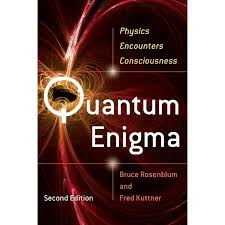
Even though I have a separate page that summarizes the most important concepts about quantum physics (see Quantumphysics) that are relevant for this site I decided to create a separate page about this particular book because it is one of the most concise and simplest explanations of various quantum phenomena. I found this it easy to read although I had to go over some passages more than once since I am not a scientist. It covers concepts such as the old Universal Law of Motion based on Newton’s worldview, Schrödinger’s Equation and the new Universal Law of Motion, the Observer Problem, the EPR paradox, Bell’s Theorem and the Copenhagen interpretation. At the end of the book the authors discuss the link between quantum mechanics and consciousness.
This is the abstract of the book:
The most successful theory in all of science–and the basis of one third of our economy–says the strangest things about the world and about us. Can you believe that physical reality is created by our observation of it? Physicists were forced to this conclusion, the quantum enigma, by what they observed in their laboratories. Trying to understand the atom, physicists built quantum mechanics and found, to their embarrassment, that their theory intimately connects consciousness with the physical world. Quantum Enigma explores what that implies and why some founders of the theory became the foremost objectors to it. Schrödinger showed that it “absurdly” allowed a cat to be in a “superposition” simultaneously dead and alive. Einstein derided the theory’s “spooky interactions.” With Bell’s Theorem, we now know Schrödinger’s superpositions and Einstein’s spooky interactions indeed exist. Authors Bruce Rosenblum and Fred Kuttner explain all of this in non-technical terms with help from some fanciful stories and bits about the theory’s developers. They present the quantum mystery honestly, with an emphasis on what is and what is not speculation. Physics’ encounter with consciousness is its skeleton in the closet. Because the authors open the closet and examine the skeleton, theirs is a controversial book. Quantum Enigma’s description of the experimental quantum facts, and the quantum theory explaining them, is undisputed. Interpreting what it all means, however, is controversial. Every interpretation of quantum physics encounters consciousness. Rosenblum and Kuttner therefore turn to exploring consciousness itself–and encounter quantum physics. Free will and anthropic principles become crucial issues, and the connection of consciousness with the cosmos suggested by some leading quantum cosmologists is mind-blowing. Readers are brought to a boundary where the particular expertise of physicists is no longer a sure guide. They will find, instead, the facts and hints provided by quantum mechanics and the ability to speculate for themselves.